Camps
Language in the wild summer camp
Language in the Wild brings students to the heart of America’s most iconic landscapes and experiences. Blending immersive English practice with classic U.S. adventures—from exploring national parks to mastering leadership skills—our exclusive camps offer a transformative journey, authentically American and uniquely designed for ambitious students ready to experience language and culture firsthand.

Language in the Wild
What to expect
The Mandarin Institute presents Language in the Wild STARTALK outdoor adventure Chinese summer camp. This is your chance to experience the best of both language and nature immersion. The entirety of the camp will be spent outdoors on a ranch in southern Idaho: Secret Canyon Ranch. We pack our days with language in fresh, new, and natural contexts, through a variety of beginning outdoor activities. Campers will be sleeping in tents, spending the day learning and practicing new skills, working with friends and teachers, connecting with the wild, and using and improving their language along with their understanding of outdoor skills and Chinese culture. This camp will run 100% in Mandarin Chinese: in order to achieve this we provide 60 hours of outdoor and online independent learning resources and activities to build proficiency, vocabulary, and background knowledge in order to stay 100% in the target language.

Language in the Wild has run 20 previous programs, and we are thrilled that STARTALK funding has made this camp completely free of cost to qualified participants aside from personal travel expenses. We do have limited travel scholarships available.
Language in the Wild
Who can attend?
This camp is designed for language learners grade 8-12 with an intermediate Chinese proficiency (this camp is not suitable for beginner and novice level Chinese speakers). Our application requires a teacher recommendation and demonstration of language proficiency. Students in a language immersion program will find it to be a perfect opportunity to expand their language proficiency beyond anything they’ve experienced in a classroom. Learners in traditional secondary language programs or heritage speakers will find our immersion setting, experienced teachers, and outdoor activities to be a powerful combination for acquiring and using new language at a variety of levels. We are a coed camp, though boys and girls sleep in different areas and in their own tents.

Our camps are for anyone who wants an awesome summer wilderness adventure while using and growing their language skills with veteran instructors and friends both new and old.
Language in the Wild
Sleeping arrangements
You have options! Our program provides large bell tents that can comfortably sleep 16+ campers, however we only assign a maximum of 7 campers in each tent. We provide two “boy” and two “girl” bell tents. You can request other camp attendees to be your “tent-mate” or we will assign campers to a tent when they arrive.

Some campers choose to bring their own tent; some sleep in it by themselves, some share it with a friend or sibling. It is also an option for campers to start out in their own tent and switch to the bell tent as they grow more comfortable or vice-versa.
We provide a kit for campers to construct their own rope cot bed. We ask you to bring your own camp sleeping pad and sleeping bag—though we can provide you both pad and sleeping bag if requested. Just let us know ahead of time.
Language in the Wild
Who we are
Our Language in the Wild programs are organized and directed by a team of seasoned educators and outdoor adventure experts: Yalan King, Eric Chipman, and Brinn Bagley. Collectively, our directors bring decades of experience in education, immersive language programs, outdoor adventures, and dual-language immersion teaching.

We’re proud to have assembled an elite group of veteran educators and outdoor enthusiasts—trusted colleagues whose expertise in summer camp organization, language instruction, teacher training, and youth leadership development is unmatched. Beyond outdoor adventures and stunning locations, our camp participants benefit from close interaction with some of the most skilled and passionate language teachers in the field.
Safety and preparation are paramount. All our instructors are trained in wilderness first aid, and our lead instructor is certified as a first responder, lifeguard, and rock-climbing instructor.
For more details about our exceptional team, visit our staff page.
Language in the Wild
Core objectives
The Language in the Wild STARTALK summer program has 4 core objectives:

- Display and illustrate an understanding of wildlife, natural systems, and wilderness skills.
- Identify and explain the natural and agricultural themes inherent in the Chinese language and culture.
- Compare and debate global challenges faced by both the US and China connected to the natural world.
- Collaborate to solve group challenges while negotiating for meaning 100% in Chinese across all camp contexts.
We will align our curriculum with the following (5) intersecting sets of standards:
- ACTFL (American Council for Teaching Foreign Languages) World-Readiness Standards of Learning Languages
- NCSSFL-ACTFL Intermediate Can-Do Statements
- NAAEE (North American Association of Environmental Education) K-12 Environmental Education: Guidelines for Excellence
- Association of Fish and Wildlife Agencies’ School-Based Outdoor Skills Education Standards
- Next Generation Science Standards
Every camp attendee is given a Language in the Wild custom nature journal with specific “Can-Do” statements derived from our core objectives and intersecting standards. Camp instructors work with each camper individually to pass off these different can-do statements throughout the camp—these can-do statements include outdoor wilderness skills, language skills, Chinese culture concepts, earth science understandings, social/community goals, and personalized “can-do” goals for each camper. The custom nature journal includes resources and guides for gaining the skill necessary to accomplish all our camps objectives. But don’t worry, each day will also include ample (and safe!) free-time for attendees to explore the natural world, play field games with new friends, and extend their practice of specific skills.
Language in the Wild
Outdoor skills and activities
No previous experience with any of our outdoor skills is required, though we can differentiate our activities for those with previous experience. With all our activities we integrate Chinese cultural comparisons and perspectives to broaden and deep campers’ understanding of the target language and culture in domains rarely encountered through formal study. Some of our activities include the following:

- Camping
- Camp cooking
- Lashing/Knot tying
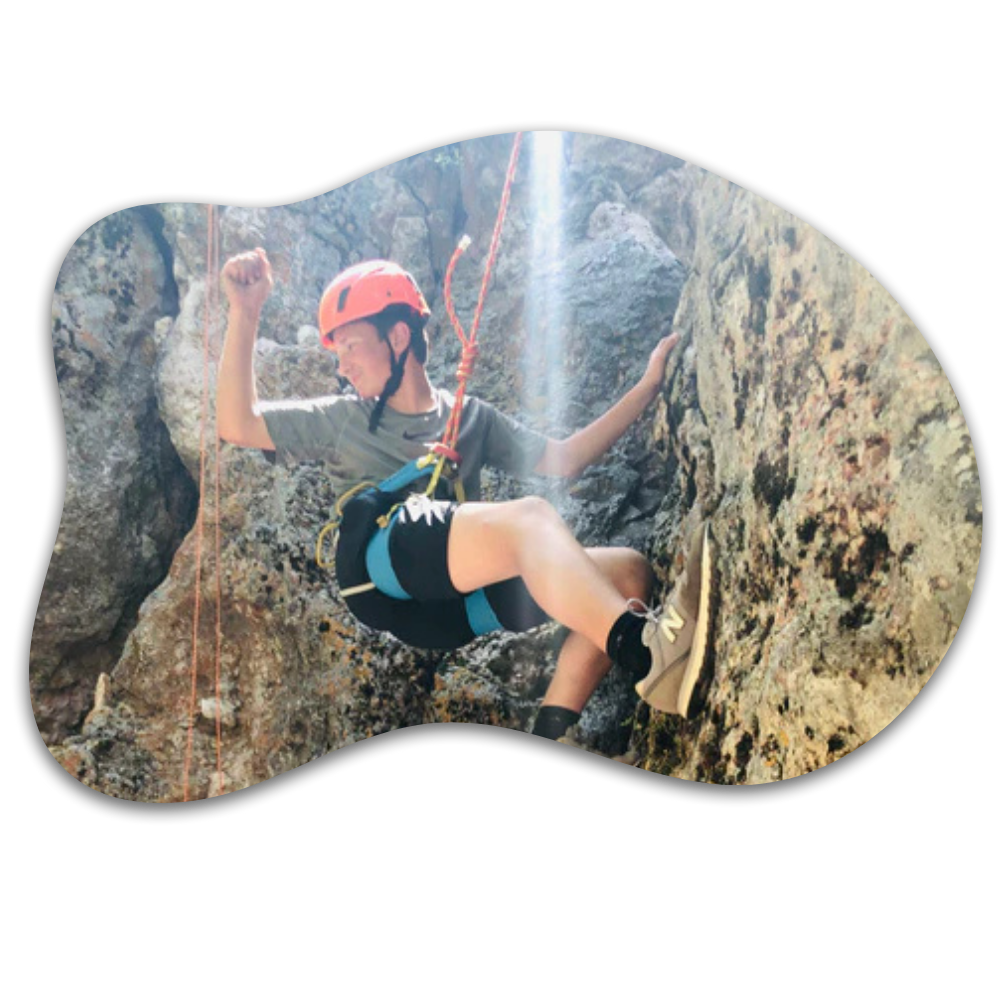
- Rock climbing
- Ropes courses/Ziplining
- River floating
- Wood carving
- Hiking
- Animal identification and tracking
- Plant identification and foraging
- Orienteering
- Astronomy/Star gazing
- Nature journaling & sketching
- Pottery
- Fire starting
- Tai-chi
- Jianzi, diabolo, and bamboo dancing
- Basketweaving
- Swimming
- Archery
- Outdoor Sports (soccer, ultimate frisbee, badminton, horseshoes, cornhole)
Campers will also learn basics about managing bison, bee keeping, cow milking, gardening, and much more.
Language in the Wild
Program Goals
Secret Canyon Ranch is conveniently located just off I-15 a few miles north of the Utah border and just outside Malad, Idaho. The location is a convenient 90-minute drive from Salt Lake International Airport, and an easy drive from anywhere else. Basecamp is less the ten minutes away from the Oneida County Hospital and other essential services, and an hour away from several major hospitals. However, campers will feel a world away from anything in this wild and remote, yet accessible location.
 anyon Ranch is conveniently located just off I-15 a few miles north of the Utah border and just outside Malad, Idaho. The location is a convenient 90-minute drive from Salt Lake International Airport, and an easy drive from anywhere else. Basecamp is less the ten minutes away from the Oneida County Hospital and other essential services, and an hour away from several major hospitals. However, campers will feel a world away from anything in this wild and remote, yet accessible location.
We have two primary camp locations: the Farm Camp and the Mountain Camp.
The Farm Camp is where the gardens, animals, farmhouses, and skill building centers are located. There are three unisex private bathrooms with flushing toilets, a washer/dryer, and outdoor showers. Campers will sleep in 20′ canvas bell tents on rope cots they will put together themselves. Attendees can also chose to sleep in a tent of their own. Camp counselors, instructors, and leadership will sleep in quarters nearby.
The Mountain Camp is about 2 miles up into the mountains from the Farm Camp. It is nestled in a hidden valley with a maple tree grove, rock cliffs and a stream fed by a nearby spring. This site is where we rock climb and put lots of our outdoor skills into practice. Campers sleep in bell tents. The bathrooms are clean compost toilets.
We have two primary camp locations: the Farm Camp and the Mountain Camp.
The Farm Camp is where the gardens, animals, farmhouses, and skill building centers are located. There are three unisex private bathrooms with flushing toilets, a washer/dryer, and outdoor showers. Campers will sleep in 20′ canvas bell tents on rope cots they will put together themselves. Attendees can also chose to sleep in a tent of their own. Camp counselors, instructors, and leadership will sleep in quarters nearby.
The Mountain Camp is about 2 miles up into the mountains from the Farm Camp. It is nestled in a hidden valley with a maple tree grove, rock cliffs and a stream fed by a nearby spring. This site is where we rock climb and put lots of our outdoor skills into practice. Campers sleep in bell tents. The bathrooms are clean compost toilets.
Language in the Wild
Daily Routines & Camp Structure
Each session of our camp has 30 total campers. We strategically divide these campers into 5 groups based on age, maturity, language proficiency, personality, and background knowledge. These groups of 6 campers are guided by a veteran Chinese teacher throughout the day with support of camp leadership, Chinese speaking camp chefs, and camp counselors.
 Every morning starts with a routine of exercise, and breakfast. Groups take turns working with the camp chef to prepare the meals (the majority of our meals are Chinese food). After breakfast we gather as a whole group to discuss the objectives and activities of the day, review vocabulary and safety instructions, and establish expectations for the day.
Campers spend the majority of the day rotating through learning and activity centers in small groups passing off can-do statements with their instructor. Campers have independent time every afternoon to play games, explore, read, wash clothes, continue projects, extend skills, or swim in our natural swimming pond.
Each night after dinner, we gather for a whole group activity, and close with a fire circle where we tell stories and act out Chinese folktales, sing songs, reflect on the day, and finish the night learning about the stars.
This routine is adjusted for “break-days” and field trips. Our break-days allow campers to access their phone, work on individual projects and skills, and relax while watching some relevant Chinese movies on our outdoor projector screen. We will also do two day trips: One day to a trailhead where we’ll hike a nearby peak; and another to lava hot springs where we will float a hot spring river and do rope courses and zip lines.
Language in the Wild
Target Language
All participants, staff, and instructors commit to communicating throughout the camp in Mandarin Chinese 100% of time. We’ve found that 100% is actually much easier to execute than 80% for example. There is no choice or question in each moment of what language to speak. The remote, natural setting of the ranch allows us to almost entirely retreat from the English speaking world and truly immerse our minds into Chinese. With over 200 hours of concentrated and super supported Chinese communication, campers will find their language proficiency noticeably improved over the course of the camp. We give campers the skills, strategies, and knowledge necessary to stay 100% in Chinese before they arrive at camp through our pre-camp program (more below)

It is important that all attendees understand that when they apply for this camp they are committing to the 100% Chinese challenge. If an attendee cannot commit to the 100% challenge we would encourage them to attend one of the many other Chinese summer camp options.
Language in the Wild
Travel to camp
Once your application has been accepted we will send out packing lists and travel information. Travel to and from camp will need to be within specific travel day windows. We will be picking up and dropping off campers on a charter bus. If you are a Utah/Wasatch Front local we will designate several pick-up/drop-off locations between the airport and the ranch.
If flying in from out-of-state, you will need to roughly arrive to the Salt Lake airport before noon on the first listed day and plan on flying out after noon on the last listed day. There is no designated airline. We have a charter bus that will pick up at the airport after everyone arrives.
Quick note on cell phones & devices
A valuable benefit of an outdoor adventure summer camp is how it can provide a much needed break from screens and phones. Our vision is that attendees can enjoy this benefit and agree to lock their phones safely away during the camp; they can access the device for any emergency. We recognize the challenge this will be for attendees, but we are excited for them to experience several days phone free in the outdoors. From our experience, campers will be shocked how satisfying it is to be free from the constant demand of their devices. They will be given time on rest-days to access their phone. Additionally, camp leaders will be updating parents/guardians on activities regularly via our See-Saw app account. We also ask students not to bring any other device such as tablets, mp3 players, headphones, headphones with storage, etc. If you need an exemption from this policy for medical reasons, etc, you can request an exemption in the application.